The End of an Era: Unpacking the Geopolitical Architecture of Iran Post-Khamenei
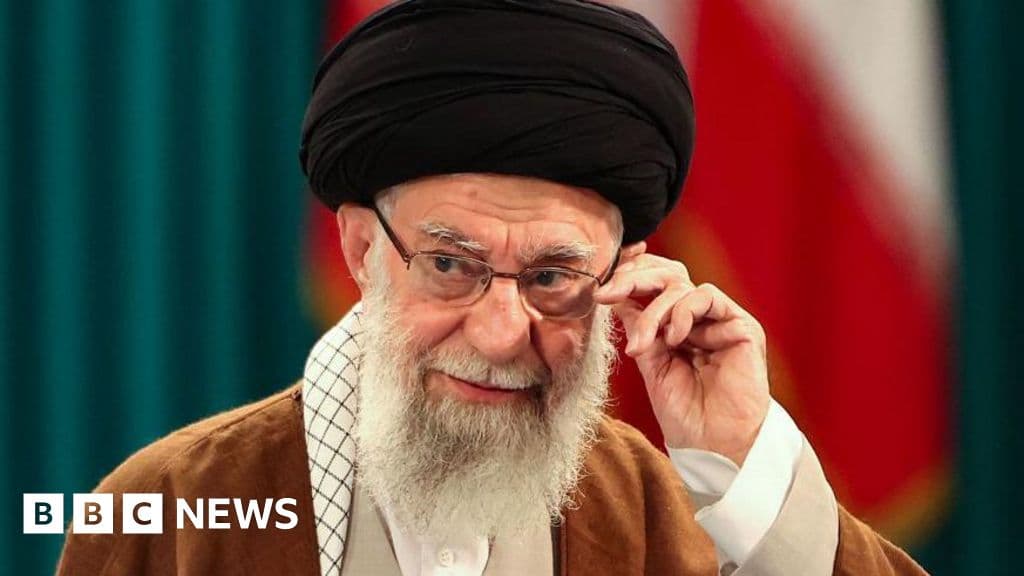
Ayatollah Ali Khamenei's death amid US-Israeli strikes ends an era, plunging Iran and the Middle East into profound uncertainty. This post explores his legacy, the architecture of his power, and what his passing means for Iran's future.
The sudden announcement of Ayatollah Ali Khamenei's demise amidst the tumultuous backdrop of unprecedented US and Israeli airstrikes on Iran marks not just the passing of an individual, but the end of a meticulously constructed epoch in Iranian history. For over three decades, the 86-year-old Supreme Leader, a figure whose influence extended into every facet of public and private life, served as the ultimate arbiter of power, ideology, and national destiny. His death, confirmed by Iranian state television, plunges a volatile region into profound uncertainty, necessitating a critical examination of the political architecture he forged and the void he leaves behind.
<h2>A Titan's Departure: Reshaping the Iranian Horizon</h2>
<h3>The Unveiling of an Era's End</h3>
Khamenei’s death, occurring under the shadow of a direct military confrontation, amplifies the immediate geopolitical tremors. His rule, the second and longest since the 1979 Islamic Revolution, represented the continuous ideological and structural underpinning of the Islamic Republic. For an entire generation of Iranians, life without his omnipresent image and authority is an unknown future. The circumstances of his death – during a period of intense military conflict – add a layer of urgency and unpredictability to the succession process and Iran's immediate posture on the global stage.
<h2>The Architects of Power: Khamenei's Ascendancy and Consolidation</h2>
<h3>From Revolutionary Zeal to Supreme Authority</h3>
Born in Mashhad in 1939, Ali Khamenei's journey from a humble, religious upbringing to the pinnacle of Iranian power is a testament to his political acumen and unwavering commitment to the revolutionary cause. Schooled in the Quran, he emerged as a potent orator and an early critic of the Shah, enduring imprisonment and torture for his activism. His close ties to Ayatollah Ruhollah Khomeini, the architect of the Islamic Revolution, saw him rise swiftly after 1979, first as Tehran’s Friday prayer leader, then as president, and ultimately, as Khomeini's successor in 1989.
His ascension, despite acknowledged shortcomings in traditional religious scholarship, highlighted a critical shift: the pragmatic prioritization of political loyalty and revolutionary credentials over pure theological eminence. This laid the foundation for a new kind of leadership, one less reliant on inherited clerical authority and more on a constructed network of power.
<h3>Weaving the Web: The Structure of Enduring Influence</h3>
Khamenei was a master architect of institutional loyalty. Over his 30-year tenure, he systematically cultivated a vast network of partisans within every key pillar of the Iranian establishment – from the Majlis (parliament) and judiciary to the media, police, and the powerful clerical elite. This intricate web, described by some as a “tight-knit cartel of hardline clergymen and nouveau riche Revolutionary Guardsmen,” became the true 'deep state' of Iran, ensuring his authority remained unchallengeable.
He established an almost unassailable position at the nexus of competing power centers, wielding the ultimate veto on public policy and personally selecting candidates for critical offices. This structural mastery allowed him to project an image of being above daily politics, while in reality, pulling all the strings from behind the scenes. This 'authoritarian architecture' ensured regime stability, even at the cost of political plurality.
<h2>A Nation Forged in Fire: Wars, Sanctions, and Ideological Steadfastness</h2>
<h3>The Crucible of Conflict: War with Iraq and Western Distrust</h3>
The Iran-Iraq War (1980-1988) was a crucible that profoundly shaped Khamenei’s worldview and, by extension, Iran's foreign policy. Witnessing the immense casualties and the use of chemical weapons, often with tacit Western support for Saddam Hussein, solidified his deep-seated distrust of the US and its allies. This period instilled in him a doctrine of self-reliance and strategic patience, which would guide Iran's engagement with the world for decades.
<h3>Navigating Isolation: The Nuclear Question and Global Tensions</h3>
Under Khamenei, Iran walked a tightrope of neither full accommodation nor direct confrontation with the West. Despite declaring nuclear weapons un-Islamic, the pursuit of a robust nuclear program became a central point of friction, leading to severe international sanctions that crippled Iran's economy and fueled widespread domestic discontent. His pragmatic, yet deeply skeptical, stance on the 2015 nuclear deal (JCPOA) underscored his long-term mistrust of Western intentions, a view seemingly vindicated by its eventual abandonment by the Trump administration.
His foreign policy also saw the strategic use of proxy forces, notably Hezbollah in Lebanon, as a means of projecting influence and confronting regional adversaries without direct state-on-state warfare. The assassination of Qasem Soleimani, a general close to Khamenei, intensified this shadow war, leading to a closer alignment with powers like Russia and China, further hardening Iran's anti-Western orientation.
<h2>The Domestic Imprint: Control, Dissent, and Societal Shifts</h2>
<h3>Iron Fist and Ideological Orthodoxy</h3>
Domestically, Khamenei's rule was characterized by a potent blend of ideological fervor and political repression. He fostered a cult of personality, with his image ubiquitous across Iran, while simultaneously crushing dissent with an iron fist. Student protests in 1999, the Green Movement in 2009, and the fuel price protests of 2019 were all met with brutal crackdowns, internet shutdowns, and widespread arrests, demonstrating his unwavering commitment to maintaining the revolution's ideological purity and the regime's control.
<h3>Generational Divide and Enduring Challenges</h3>
While enabling greater access to education for women, Khamenei remained an ardent opponent of gender equality. His tenure saw the brutal persecution of women campaigning against mandatory hijab and human rights lawyers supporting them. The death of Mahsa Amini in police custody in 2022 sparked unprecedented nationwide protests, revealing a profound generational divide and simmering discontent against the very foundations of the Islamic Republic, which he had so painstakingly upheld.
<h2>Beyond the Architect: Anticipating Iran's Next Chapter</h2>
<h3>The Vacant Throne: Questions of Succession and Stability</h3>
Khamenei’s death, particularly under such violent circumstances, leaves a significant vacuum at the core of Iran’s political structure. The Assembly of Experts, a council of clerics, is tasked with selecting his successor. The process is opaque, but will undoubtedly be influenced by the hardline factions and the Revolutionary Guards whose power he cultivated. The successor will inherit a nation in crisis, embroiled in direct conflict, facing a deeply fractured economy, and simmering internal dissent.
<h3>A Legacy's Echo: Repercussions for the Region and the World</h3>
Khamenei’s passing is a tectonic shift for Middle East geopolitics. His successor will face immense pressure to navigate the ongoing conflict with the US and Israel, address the economic woes, and manage the expectations of a young, restless populace. The path chosen by the next Supreme Leader will determine whether Iran leans further into confrontation or seeks a new equilibrium, impacting regional stability and global power dynamics for years to come. The 'architecture' of power he built will now be tested, potentially reshaped, by a new hand at the helm.
"Architectural silence is often the most profound statement a structure can make. It creates space for the mind to breathe."— The EverGreen Compendium
Comments
No comments yet. Be the first.